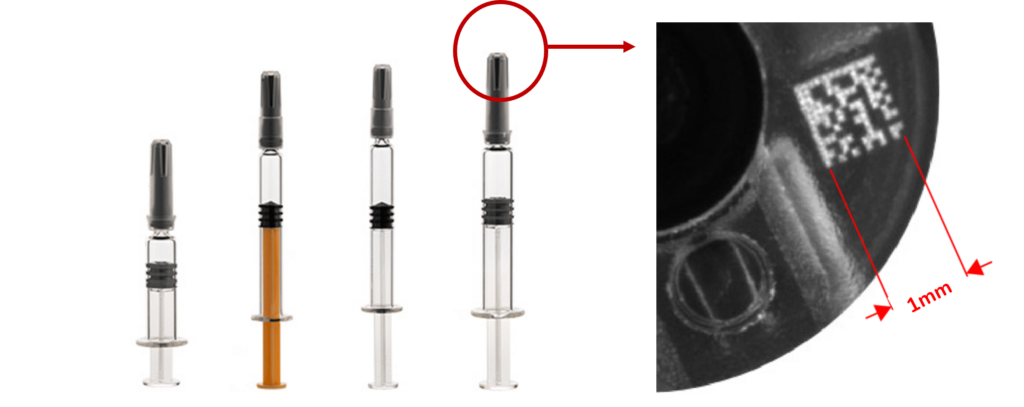
UDI serialization is no longer a novelty it’s a requirement. But for many manufacturing sites, it’s synonymous with slowdowns or compromises. Did you know that most conventional marking systems hit a ceiling as soon as data complexity increases? At Qiova, we believe that traceability should be an accelerator, not a hindrance.
The true test of serialization is not marking a 2D Datamatrix code, but ensuring its perfect readability (Grade A or B) on millions of units without interruption.
Inkjet printers do not support serialization on primary packaging; while they have relatively low CAPEX, OPEX and maintenance requirements remain high, negatively impacting ROI and contamination risks in sterile production.
RFID chips appear as a perfect technical solution with collective remote reading promises, but the cost per part identified makes them unsuitable for individual serialization in high volume production.
Single-beam lasers enable reliable, long-lasting individual serialization but are slow since they use only a single beam.
Thanks to the VULQ1-S’s multibeam technology, we reduce marking time by a factor of 5 compared to a single-beam laser.
The result? A perfect GS1 Datamatrix in less than 50 ms, seamlessly delivered on the world’s fastest fill & finish lines (> 400 ppm).
2. Mastering marking on complex primary packaging (PE, PP, glass)
Compared to the recurring costs of inkjet consumables or the exorbitant unit price of RFID, the multi-beam laser offers an unbeatable ROI for production volumes of 10 million units per year. It is a fully automated “zero-maintenance” solution that maximizes the uptime of your production lines.
By choosing the multibeam system, you are implementing a solution capable of scaling with your needs, ensuring optimal ROI with drastically reduced cost per unit and environmental footprint.